Recent Posts




The Role of Government Relations in Saudi Arabia
Foreign companies entering Saudi Arabia often discover that the regulatory environment is as demanding as the market opportunity itself.
Ministry approvals, Saudization compliance, licensing requirements, and government engagement all require careful management from day one. The cost of getting any one of them wrong, whether through a missed deadline, an incomplete submission, or an mishandled government relationship, is measured in lost time, financial penalties, and missed commercial opportunities.
The organizations that operate without these setbacks are the ones that secured the right government relations support in Saudi Arabia before they needed it.

What Saudi Arabia’s Q1 2026 Commercial Registration Data Signals for Foreign Investors and Market Entrants
Saudi Arabia recorded 71,000 new commercial registrations in Q1 2026, bringing the Kingdom’s total to approximately 1.89 million. For foreign investors and businesses considering entry into the Saudi market, these numbers tell an important story — one that goes beyond statistics.
Read More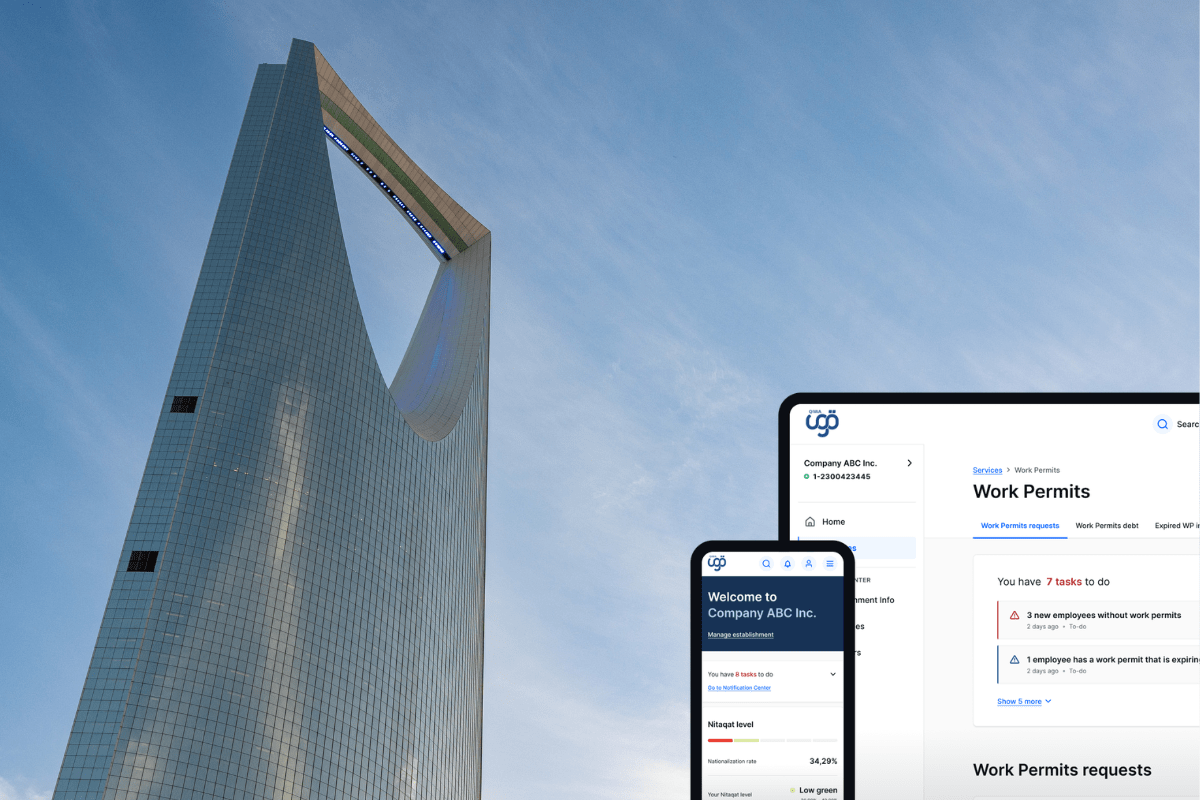
How Qiwa Restrictions Are Impacting Visa Processing in Saudi Arabia
In 2026, the Kingdom of Saudi Arabia introduced a series of regulatory adjustments that are reshaping cross‑border workforce mobility and visa processing. At the center of these developments is the Qiwa platform, the government’s unified labor and immigration ecosystem designed to digitalize workforce compliance. Recent restrictions implemented through Qiwa — particularly those tied to Saudization mandates — are affecting how companies plan, process, and secure work visas for expatriate employees.
Read More
How EOR Services Handle Saudization Compliance on Behalf of Foreign Companies
For a foreign company entering Saudi Arabia, the business opportunity is clear. The compliance landscape is considerably less so.
Saudi Arabia’s economy expanded 4.5% in 2024, unemployment has reached historic lows, and net foreign direct investment climbed to USD 5.9 billion in the first quarter of 2025 alone, a 44% jump from the same period a year earlier. International businesses are moving in at a pace the Kingdom has not seen before. But sitting inside every market entry plan is a requirement that consistently trips up even well-prepared organizations: Saudization.
Read More
Nitaqat Saudization Update 2026: Why Qiwa Contract Documentation Is Now Non-Negotiable for Saudi Employers
The Ministry of Human Resources and Social Development (MHRSD) has updated the Nitaqat Saudization calculation system, making Qiwa contract documentation a mandatory requirement effective April 15, 2026. Employers who fail to document their Saudi employee contracts on the Qiwa platform risk having those employees excluded from their Saudization headcount, potentially triggering a Nitaqat classification downgrade with significant business consequences. Here is what your organization needs to know and do before the deadline.
Read More
Digital Employment Contract Saudi Arabia: Rights for Expat Workers
Saudi Arabia’s hiring and immigration environment continues to evolve as the Kingdom strengthens digital governance across its labour market. Recent labour reforms are placing greater emphasis on transparent employment documentation, digital contract verification, and wage compliance for companies hiring expatriate workers.
Read More
Workforce Mobility During Regional Tensions (2026)
International workforce mobility during regional tensions has become an increasingly important consideration for companies expanding across global markets. Organisations continue to relocate executives, engineers, and specialists to support operations and major development projects.
In 2026, however, geopolitical tensions and aviation disruptions across parts of the Gulf have introduced new challenges for corporate relocation planning. Airspace restrictions, flight rerouting, and updated travel advisories are affecting travel schedules and visa timelines.
As a result, organisations deploying staff across the Middle East must adopt more structured mobility strategies.
A key question now arises: how can companies safely and efficiently relocate employees during periods of regional uncertainty?
Effective risk planning, travel advisory compliance, and relocation contingency strategies have therefore become essential components of modern workforce mobility during regional tensions.
Read More
Employer of Record (EOR) Solutions in Saudi Arabia
Saudi Arabia’s economy continues to expand at pace. With total employment surpassing 18 million and foreign investment steadily increasing under Vision 2030, international companies are actively exploring ways to hire talent in the Kingdom without immediately establishing a local legal entity.
In 2026, Employer of Record (EOR) solutions in Saudi Arabia have become one of the most practical and strategic options for global businesses seeking compliant, low-risk market entry.
An EOR allows companies to legally employ staff in Saudi Arabia while avoiding the complexity, cost, and time associated with setting up a subsidiary. For Companies testing the market, deploying specialists, or expanding across the GCC, this model offers both flexibility and compliance assurance.
Read More
PRO and GRO Support for Foreign-Owned Companies in Saudi Arabia
Saudi Arabia is growing fast. New companies are entering the market, regional headquarters are being set up in Riyadh, and large-scale projects are driving demand for skilled professionals.
But while opportunity is expanding, so are regulatory requirements.
Behind every successful company operating in the Kingdom is something many people don’t see — a strong PRO and GRO function managing government processes smoothly and quietly in the background.
If you are searching for PRO services in Saudi Arabia, outsourced GRO support in Riyadh, or government liaison services for business setup, this guide explains what you really need to know — in simple, practical terms.
Read More
Saudi Family Visa Rules for Expat Parents & Children in 2026
Relocating to Saudi Arabia is no longer viewed as a short-term professional assignment. In 2026, many expatriates are relocating with long-term intent — bringing spouses, children, and in some cases, parents. However, before planning a move, one critical question must be addressed: What are the current Saudi family visa rules for expat parents and […]
Read More